
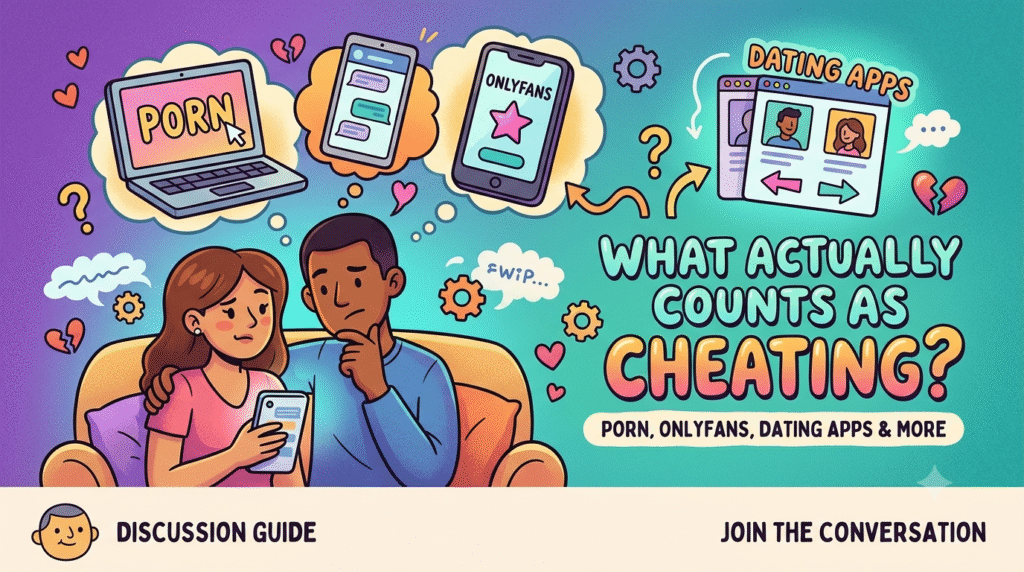
Let me say something first: there’s no one rule everybody agrees on. Ask ten people and you’ll get ten answers. I’ve seen couples break up over a “like” on Instagram, and I’ve seen couples shrug off stuff that would end other relationships.
So I’m not here to hand you a rule. I’ll walk you through how I’d think about it, and how you can figure out where your own line is.
Three different things people mix up
Before we get into specifics, it helps to separate three ideas, because most arguments about cheating are really arguments about which one is happening.
1. A boundary. This is a personal limit. “I’m not comfortable with you following models on Instagram.” It’s your feeling, and it matters, but if you’ve never said it out loud, your partner can’t break it on purpose.
2. A broken agreement. This is something you both said yes to. “We’re exclusive. No dating apps.” If one of you goes against it, that’s a real breach, even if nothing physical happened.
3. Infidelity. This is the big one: romantic or sexual involvement with someone else, outside whatever your relationship allows.
Why this matters: a lot of couples fight as if #1 is #3. “You looked at porn, you cheated!” Maybe, maybe not. First figure out whether there was an agreement, and whether it was broken. And if you never talked about it, the first fix isn’t a breakup. It’s a conversation.
Is it cheating? A quick reference table
Here’s the honest version. There’s no universal answer, but here’s how most people see it — and where it depends on your relationship.
| Behavior | Usually cheating? | Why / Depends on |
|---|---|---|
| Physical sex with someone else | Yes | Almost universally considered infidelity in a monogamous relationship. |
| Emotional affair (deep intimacy with someone else) | Yes | Sharing things with someone else you’d never share with your partner. Often hurts more than physical cheating. |
| Active dating profile | Yes | Even without meeting up. Signals you’re available. Exception: open relationships. |
| Flirty texts that go past friendly | Yes | Secret flirtation with someone you’re attracted to. If you’d hide it, it crosses a line. |
| Secret meetups with an ex | Yes | Even “just coffee.” If you didn’t tell your partner, that’s the problem. |
| OnlyFans / paid content with interaction | Depends | Paying a real person who talks back crosses a line for many. Secret spending is a betrayal either way. |
| Watching porn alone | Usually no | Most people don’t count it. Becomes a problem if it’s secret after you’ve discussed it, or it replaces intimacy. |
| Following attractive people on Instagram | Usually no | A boundary issue, not cheating. Unless you’ve agreed it’s off-limits. |
| Close friendship with an ex | Depends | If it’s open and your partner knows, usually fine. If it’s secret, it’s a trust problem. |
| Hiding your past | No | You don’t owe every detail. But lying when directly asked damages trust the same way. |
| Liking a coworker’s photo | No | Not cheating. But if it bothers your partner and you keep doing it, that’s a different conversation. |
| Having a “work spouse” | Depends | If it’s an emotional affair, yes. If it’s a friendship and your partner knows, usually no. |
| Masturbating | No | Not cheating. It’s a normal part of most people’s lives. |
| Secretly spending money on another person | Yes | Financial betrayal alongside emotional betrayal. The secrecy is the issue. |
Notice the pattern? The act matters less than the secrecy. If you’re hiding it, lying about it, or feeling guilty about it, that’s usually the real signal.
The simple test
The question I’d start with: is it being hidden?
If you’d be fine with your partner watching over your shoulder, it’s probably okay. If you’re deleting messages, changing passcodes or telling small lies to cover it, that’s a sign you already know it crosses something.
Cheating usually isn’t just about the act. It’s about breaking an agreement and lying about it.
Porn
This one splits people the most. Some couples watch together. Some don’t care. Some feel hurt or compared to people they can’t look like.
It becomes a problem when it takes over, when it hurts how you two connect, or when your partner has clearly said it bothers them and you keep doing it in secret. Watching porn alone usually isn’t “cheating” by most people’s standards. Lying about it after you’ve talked about it is a trust problem.
OnlyFans and paid content
This is different from regular porn, because it can be interactive. You’re paying a real person, and sometimes chatting with her or getting messages with your name in them.
Subscribing to someone who talks back, sends custom content or builds a personal connection crosses the line for a lot of people. And there’s money too: spending hundreds a month in secret is a betrayal of trust even if nothing physical happens.
A good check: if your partner did the same thing, would you be okay with it? If not, it’s worth a conversation.
Dating apps
This one is a lot clearer than the others.
Even if you never meet anyone, creating or keeping a dating profile while in an exclusive relationship can cross a serious boundary. It means you’re signaling that you’re available, and that’s usually the opposite of what exclusive means. People give reasons like curiosity or an ego boost, and some of those may be true. But for most couples, an active profile breaks the agreement.
The exception is a relationship you both agreed is open. Then it’s a different conversation.
Seeing or flirting with someone else
Dating someone else while you’re in a committed relationship is cheating. So are flirty texts that go past friendly, secret meetups and “just coffee” with someone you’re attracted to and haven’t told your partner about. Whether or not it got physical, it’s usually a clear break of the agreement.
What about hiding your past?
This is a gray area, so let me be fair.
Everyone has a past. You don’t owe your partner every detail of your life before them. An ex, an old hookup, a mistake from years ago. That’s your history.
But some things matter:
- Things that directly affect your future together (kids, marriage, debts, anything that touches them)
- Something you hid and they found out from someone else
- Lying when they asked you directly
Hiding your past isn’t cheating on its own. But lying about it, especially when asked straight, damages trust in a similar way. And if you’re still in touch with someone from that past, that’s a separate issue.
Can you check if someone is on dating apps?
If something feels off and you can’t let it go, the CatchingCheating tool lets you check whether a person might have a dating profile. It can give you one piece of information you didn’t have.
Please keep this in mind: a search result by itself doesn’t prove cheating. A profile could be old and forgotten. It could be someone who looks similar. It can’t tell you what someone’s intentions were, whether the account is active, or whether anything actually happened.
So use it as a starting point, not as a verdict. If you find something, take a breath and ask a calm question before you decide anything. Suspicion isn’t proof, and treating it like proof is how people end relationships over mistakes.
How to keep your relationship strong
Say your lines out loud. Most couples never actually talk about what counts. Sit down once and ask: porn, social media, friends of the opposite sex, what’s okay and what isn’t? It’s better to find out you disagree now than in the middle of a fight.
Don’t let small stuff slide. If something bugs you, say it early and keep it short. “That thing bothered me a little.” Waiting six months and then exploding doesn’t work.
Spend real time together. A lot of cheating starts when two people stop paying attention to each other. Put the phones down. Ask how their day actually was.
Don’t hide small things. Little lies teach you both that lying is normal.
Check in once in a while. Not an interrogation. Just: “How are we doing? Anything I should know?”
If you caught your partner cheating
First, I’m sorry. It hurts, and whatever you’re feeling is normal.
- Don’t act in the first hour. Don’t text them, post anything or show up anywhere. Anger feels like clarity, but it isn’t.
- Separate what you know from what you’re guessing. Write it down if that helps.
- Talk to them when you’re calm. Ask direct questions. Listen to the answers, and notice if the story changes.
- Tell one person you trust. Don’t carry this alone.
- You don’t have to decide tonight. Some couples rebuild after cheating and some are better off ending it. Both are valid.
- Figure out what you need. Honesty, a real apology, counseling, space. If they can’t give you any of it, that tells you something.
- Look after yourself. Sleep, eat, move. A therapist can help if it feels heavy.
One last thing
Nobody deserves to be lied to. If you’re here because you’re worried, I hope you find what you need, whether that’s the truth or some peace of mind.